
Disinformation is changing faster than our ability to understand and counter it. But the expertise needed to respond already exists — across research, journalism, cybersecurity, public institutions and civil society. The challenge is connecting it.
Today, we are introducing the renewed Disinformation Space: a research and community resource centre dedicated to understanding AI-enabled information manipulation, making existing capabilities visible and developing opportunities for interdisciplinary collaboration.
From Dresden to something lasting
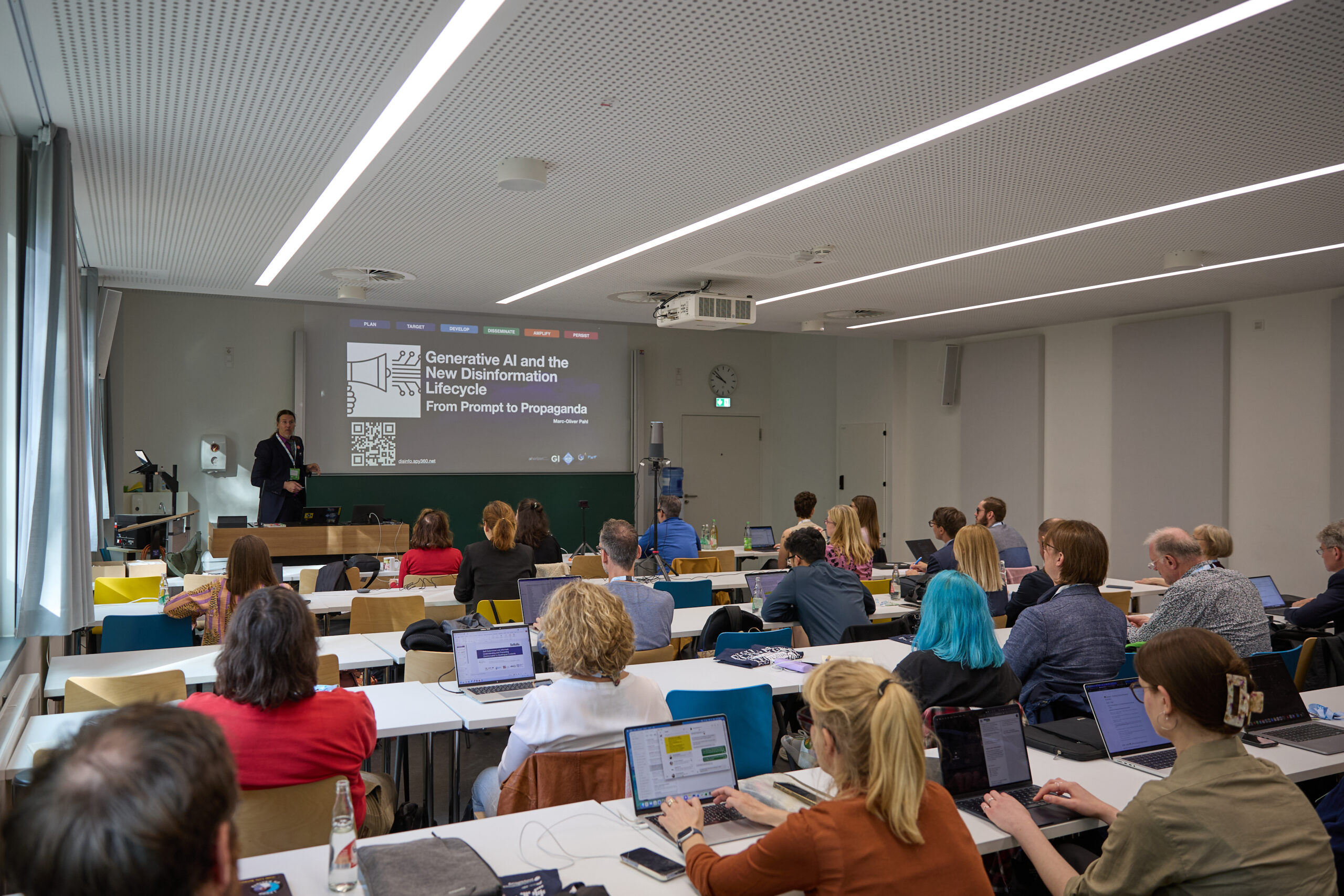
The initiative builds on the international workshop From Prompt to Propaganda: Generative AI and the New Disinformation Lifecycle, held on 22 September 2026 during INFORMATIK FESTIVAL in Dresden. Conceived and moderated by Marc-Oliver Pahl, the workshop connected scientific contributions with professional fact-checking, national ecosystem perspectives from Germany, France and Ukraine, governance discussions and interactive experimentation.
The workshop was supported by collaborators from the Gesellschaft für Informatik, aihorizon R&D and research institutions, with contributions from the German Chapter of the ACM, IFIP and a broad interdisciplinary network. We are grateful to the speakers, scientific authors, organisers and participants whose perspectives made this synthesis possible.
What emerged from the workshop?
The central lesson is that information manipulation cannot be understood by looking only at individual fake news items or synthetic images. The workshop’s synthesis suggests three shifts in perspective:
- From content to operations: understand how planning, targeting, generation, distribution, amplification and persistence interact.
- From a single chain to interacting flows: distinguish the information being distributed from the audience data used to select and reach people.
- From online-versus-offline to social feedback: recognise that manipulation draws on real-world tensions and vulnerabilities from the outset, while its effects can reshape that environment.
The resulting open-access report identifies eight cross-cutting findings and thirteen emerging research challenges. These are exploratory outcomes of an interdisciplinary workshop — a starting point for further validation and collaboration, not a claim that the field has already reached consensus.
Explore the new resource centre
The redesigned website brings together several resources in one place:
- Eight key findings and their implications for research and practice.
- An evolving research-project and capability map, initially grounded in Dresden’s contributors.
- A research agenda identifying questions and potential collaboration interfaces.
- Scientific publications and workshop reports, including the full citable report.
- The Dresden workshop archive with recordings and a narrative of the outcomes.
Watch the outcomes — and explore the evidence
For a short introduction, watch our workshop outcomes film. For the full scientific and expert contributions, explore the recordings playlist. The detailed synthesis is permanently available as Pahl (2026), From Prompt to Propaganda — Workshop Report, Ecosystem Cartography and Research Agenda, Zenodo, version 1.0.
Help build the next phase
Disinformation Space is intended to grow beyond a single event. We want to connect existing research projects and operational capabilities, identify gaps and shared experimental needs, and encourage new collaborations across disciplines and borders.
Are you working on disinformation, information integrity or AI-enabled influence operations? Explore the resource centre, share relevant projects and research outputs, and subscribe to follow the next steps. The directory and research agenda are evolving, and contributions from the wider community are welcome.
Workshop photography: Photos Mike Auerbach/ GI.
Leave a Reply